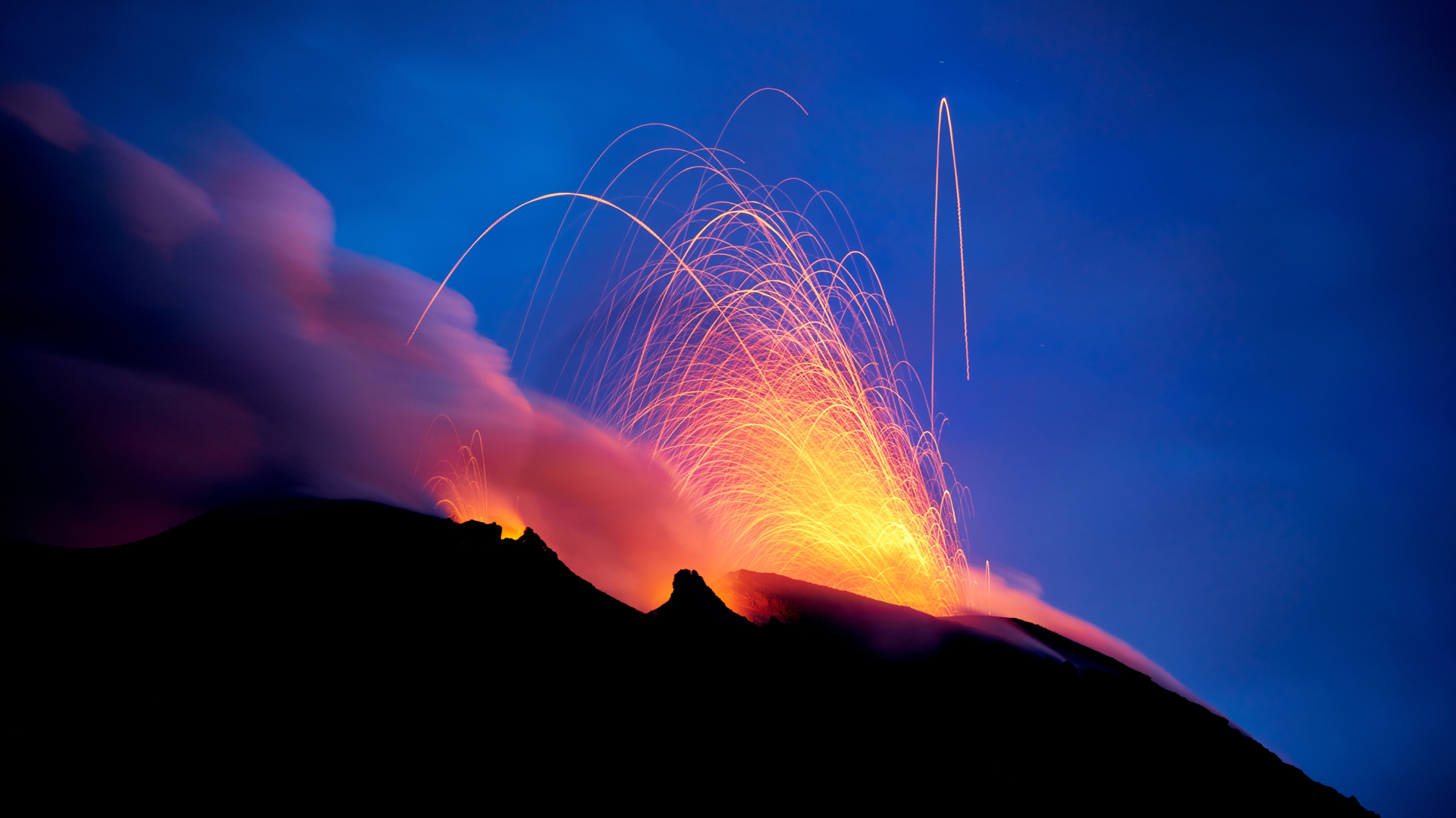


About 4.6 billion years ago, Earth was not the blue, temperate planet we know today. It was a world in turmoil: a boiling surface, ember-coloured skies, and chains of volcanoes erupting across the globe. A landscape that seems straight out of a nightmare, but which, paradoxically, may have been the cradle of life.
Imprima ou partilhe nas suas redes sociais:
July 2026
The idea that geology and biology are closely connected disciplines is not new, but it is rarely told in the way it deserves. Most people look at a volcano and see destruction. Scientists see a planetary-scale chemical laboratory, where the first molecules of life may have been synthesised millions of years ago: our cradle.
The planet that began with fire
Volcanism, the set of processes involving the ascent of magma (molten rock) from Earth’s interior to its surface, is as old as the planet itself. Since Earth’s formation around 4.6 billion years ago, volcanic activity has shaped the Earth’s crust, sculpted mountains, created islands, and transformed the composition of the atmosphere.
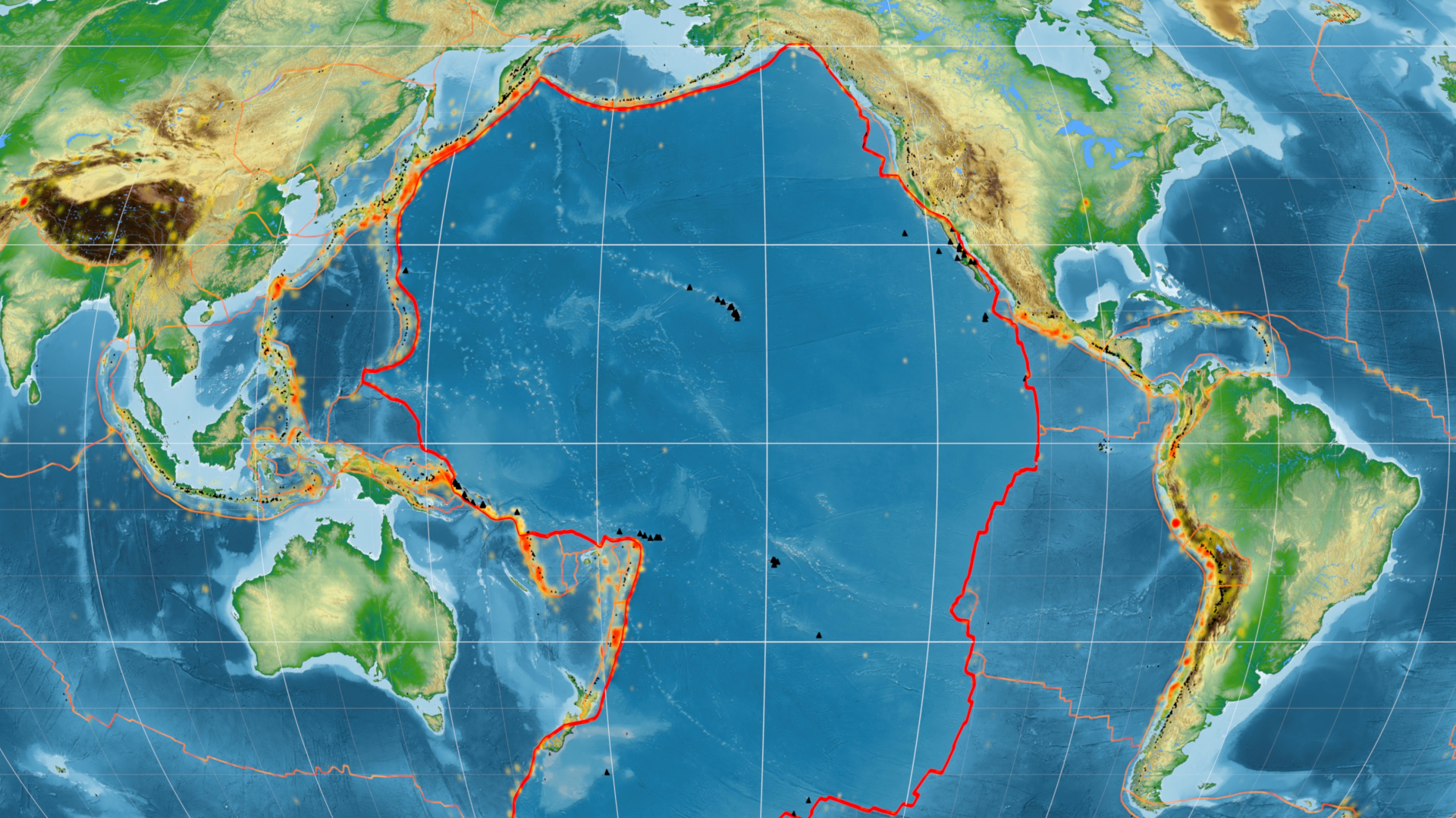
This activity has two main origins. The first is linked to the movement of tectonic plates (large rigid blocks that make up Earth’s crust and move slowly over the mantle, the hot, viscous layer beneath). When these plates collide or move apart, they create fractures through which magma rises to the surface. This is why the vast majority of active volcanoes are concentrated along plate boundaries, such as the so-called Pacific Ring of Fire, where 90% of the world’s earthquakes and 75% of Earth’s active volcanoes occur. This belt of geological instability stretches for 40,000 kilometres, extending from the Americas to East Asia and Oceania, as shown in red in the image below.
The second source is what are known as mantle plumes (columns of unusually hot magma that rise from deep within the Earth and penetrate the rocks of the crust). This is how the Hawaiian Islands formed, in the middle of the Pacific Ocean, far from any tectonic plate boundary.
The young Earth and the primitive atmosphere
During Earth’s first billion years, volcanism was far more intense than it is today. Continuous eruptions released gases that gradually built up the planet’s primitive atmosphere layer by layer. Without oxygen, this atmosphere consisted of a mixture of nitrogen, carbon dioxide, methane, and water vapour, very different from the air we breathe today.
One of the classic hypotheses for the origin of life is the so-called “primordial soup” hypothesis, proposed in the 1920s by the Russian biochemist Aleksandr Oparin and the British biologist J. B. S. Haldane. Both believed that the first organic molecules formed in an aqueous mixture rich in chemical compounds, a scenario that relies precisely on the existence of an atmosphere rich in the gases released by volcanoes.
In 1953, American scientists Stanley Miller and Harold Urey recreated this primitive atmosphere in the laboratory and passed electrical discharges through it. The result was the spontaneous formation of amino acids (the building blocks of proteins, which are themselves the building blocks of life). Volcanism was, quite literally, built into the experiment.
Volcanic lightning: when storms meet chemistry
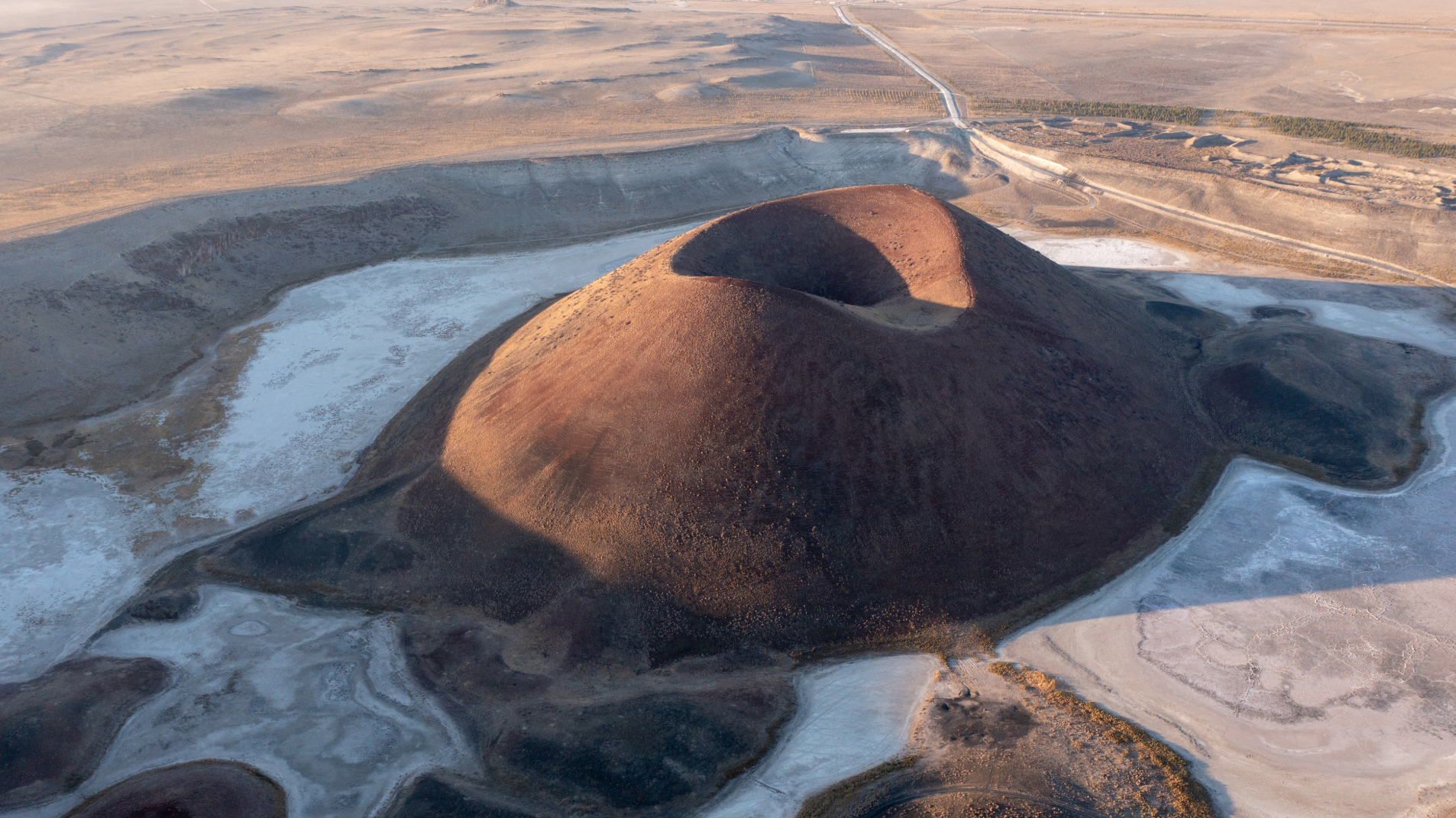
Major explosive eruptions generate immense ash clouds that can rise into the stratosphere (the layer of the atmosphere located between 12 and 50 kilometres above Earth’s surface). Within these clouds, friction between particles generates static electricity and lightning. A lot of lightning. A study published in 2024 in the Proceedings of the National Academy of Sciences led by geoscientist Adeline Aroskay of Sorbonne University brought something new to the discussion: for the first time, significant quantities of nitrates (compounds containing already fixed nitrogen) were found in volcanic deposits from ancient explosive eruptions in both Turkey and Peru, dating from 1.6 to 20 million years ago.
Why does this matter? Because nitrogen is an essential nutrient for life, indispensable for building proteins, amino acids and nucleic acids, the molecules that store and transmit genetic information. Around 78% of the atmosphere is made up of molecular nitrogen (N₂), but cells cannot use it in that form. Nitrogen atoms must be “excited” to form heavier compounds that precipitate onto the Earth’s surface. Before life existed, volcanic lightning appears to have been energetic enough to do precisely that.
The missing geological evidence
What made the study by Aroskay and her team particularly important was the discovery of direct geological evidence. The samples collected showed that nitrate concentrations did not vary with the age of the deposits: they had been deposited all at once, during the eruption itself.
The researchers’ calculations estimate that a single large explosive eruption can fix, on average, around 60 teragrams of nitrogen, equivalent to 60 million tonnes. On the young Earth, this would have provided a continuous and abundant supply of the ingredients needed to kick-start the process.
The destructive side of the same force
The relationship between volcanism and life is also a story of catastrophe. Around 251 million years ago, at the end of the Permian Period, a series of colossal eruptions in what is now Siberia created the Traps, or “steps” (from Sanskrit), vast volcanic rock formations produced by prolonged fissure volcanism. Below is the Putorana Plateau and its traps.
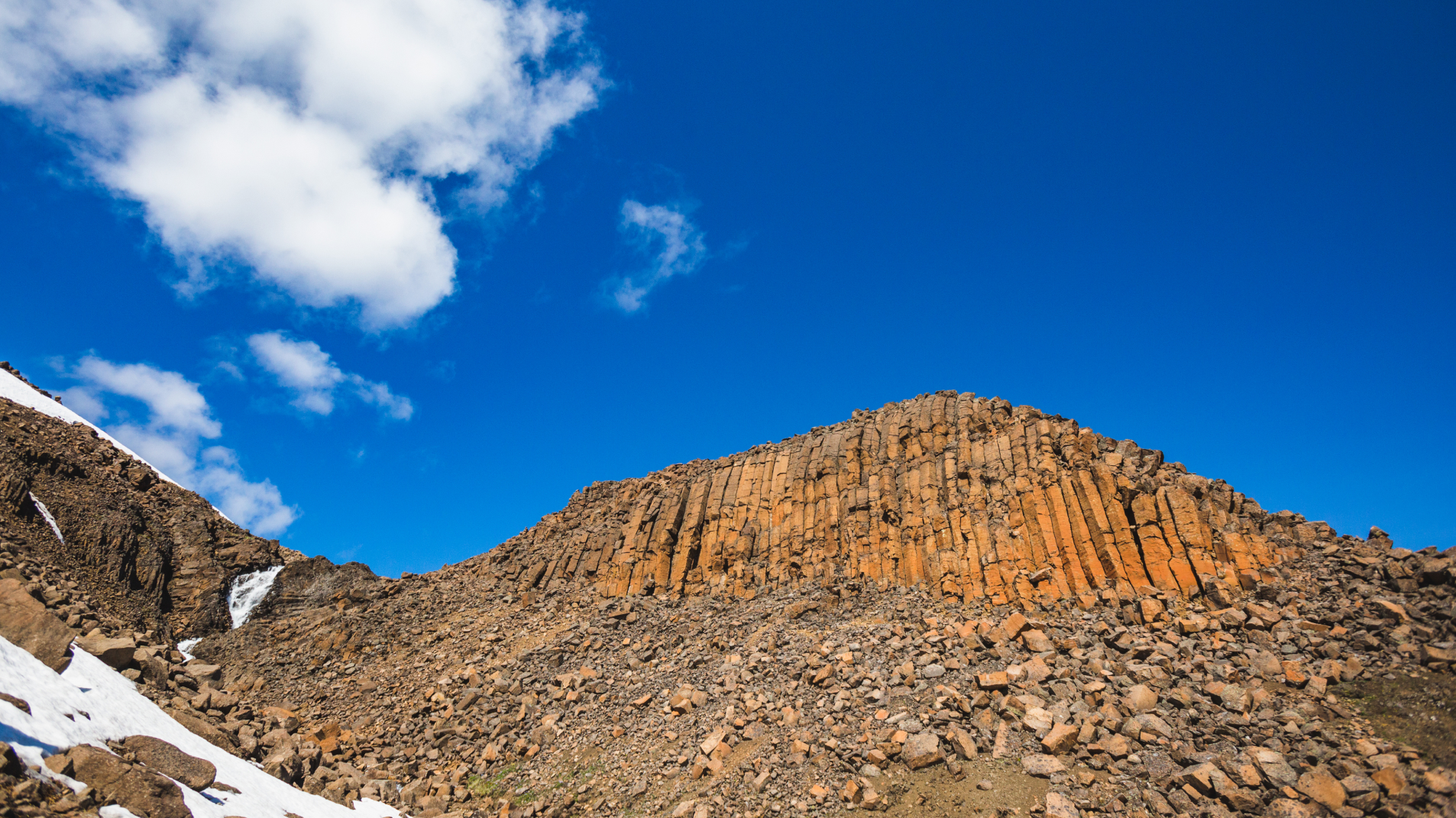
These formations cover several thousand square kilometres and reach more than three kilometres in thickness. The eruptions lasted for approximately two million years and triggered dramatic global warming and ocean acidification. The result was the largest mass extinction in Earth’s history: between 90 and 96% of marine species and around 70% of terrestrial species disappeared.
The same force that may have given rise to life was, and still is, capable of almost wiping it out. At the end of the Cretaceous Period, 66 million years ago, the Deccan volcanism, together with an asteroid impact, contributed to the extinction of the non-avian dinosaurs, along with many other forms of life. In 1985, Nevado del Ruiz in Colombia triggered lahars (volcanic mudflows) that destroyed the town of Armero and killed more than 23,000 people, not to mention examples such as Pompeii, Krakatoa, Santorini, or Saint Helens.
Active, dormant and extinct volcanoes?
An active volcano is one that has erupted within the last ten thousand years, is currently erupting, or shows signs that it may erupt again in the near future. An extinct volcano shows no indication of future activity. Between these two extremes are dormant volcanoes, which have shown no activity for centuries or even millennia but still retain the potential to awaken. In practice, distinguishing between an extinct and a dormant volcano is not always straightforward.
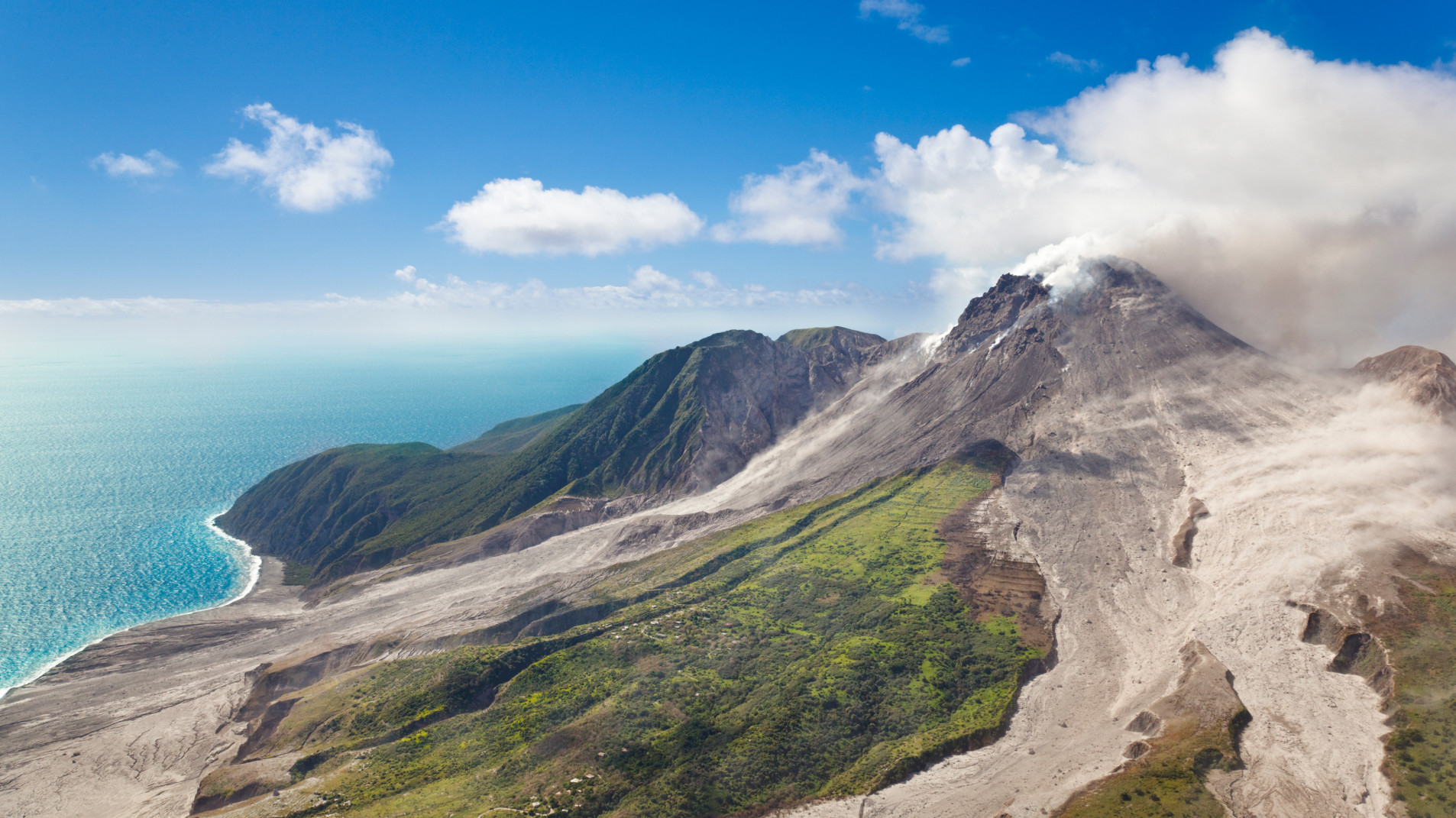
The Soufrière Hills volcano on the Caribbean island of Montserrat (pictured below) was classified as extinct when, in 1995, it erupted violently, forcing the partial evacuation of the island. It has remained active ever since. This uncertainty is part of the nature of volcanoes and is also what makes them so fascinating to scientists.
Volcanism as a link between two worlds
The boundary between geology and biology is often drawn as a clear dividing line. Rocks on one side, organisms on the other. But the story of volcanism and the origin of life erases that distinction.
Volcanoes helped build the atmosphere that life breathes. They supplied the chemical compounds that life depends on. They generated the energy, in the form of heat, lightning, and ultraviolet radiation, that drove the first chemical reactions. And over the course of four billion years, they continued to reshape the environments in which life evolved, diversified, and at times came close to disappearing.
There is something profoundly unsettling about this: life emerged from chaos. Not despite it, but because of it.
Did you know?
- Mainland Portugal experienced volcanic activity during the age of the dinosaurs. The Sintra, Sines and Monchique massifs were formed between 70 and 100 million years ago from a mantle plume that would later give rise to the Madeira and Canary Islands.
- Volcanic lightning can be more frequent than the lightning produced during a typical thunderstorm. During major explosive eruptions, ash clouds can generate hundreds of electrical discharges per minute, as recorded at Alaska’s Redoubt Volcano in 2009.
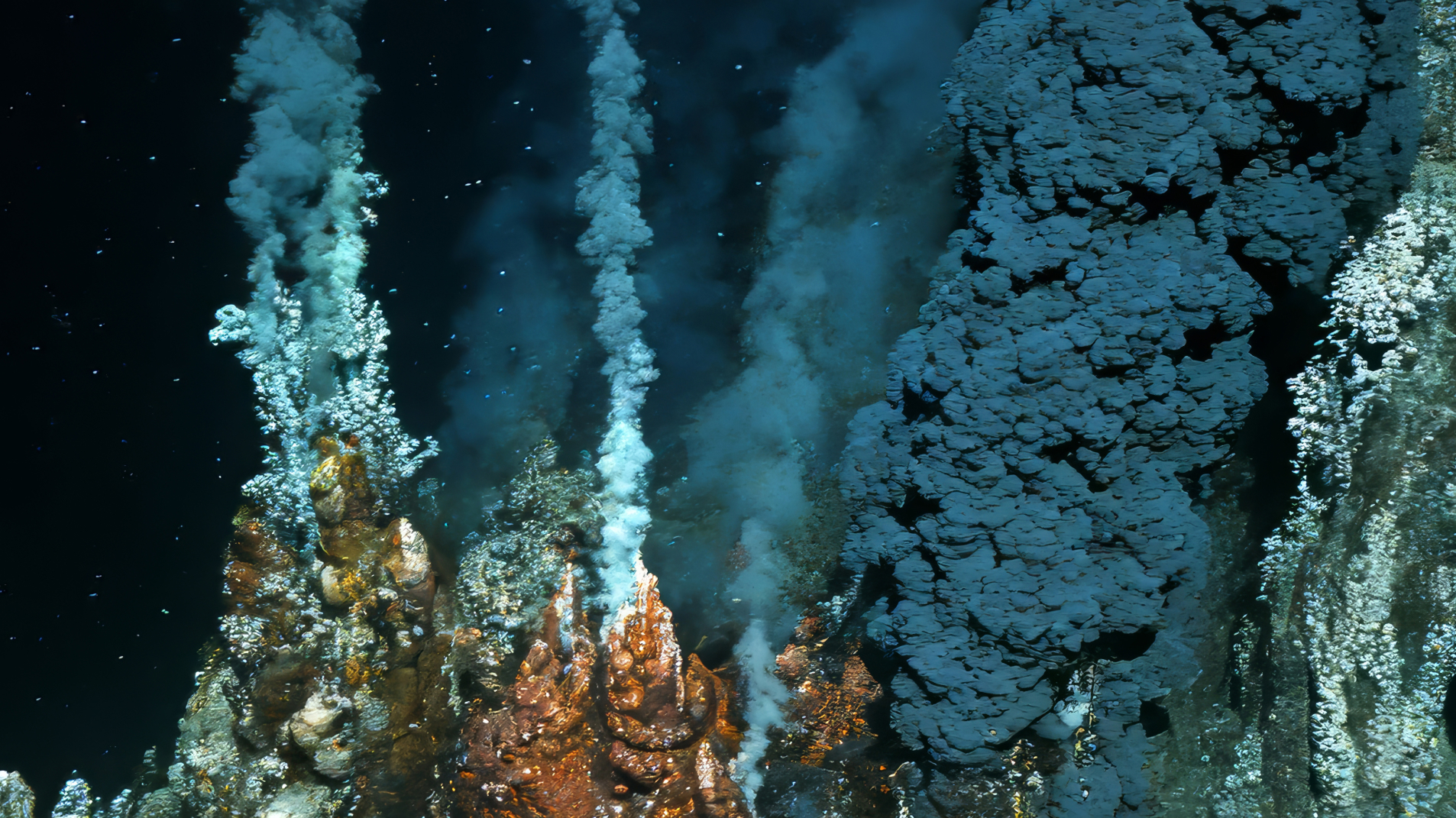
- Submarine fumaroles may still be cradles of life today. Hydrothermal vents (openings on the ocean floor that release hot, mineral-rich fluids generated by submarine volcanic activity) support entire communities of organisms that do not depend on sunlight. Scientists believe that life on Earth may have originated in precisely these environments.