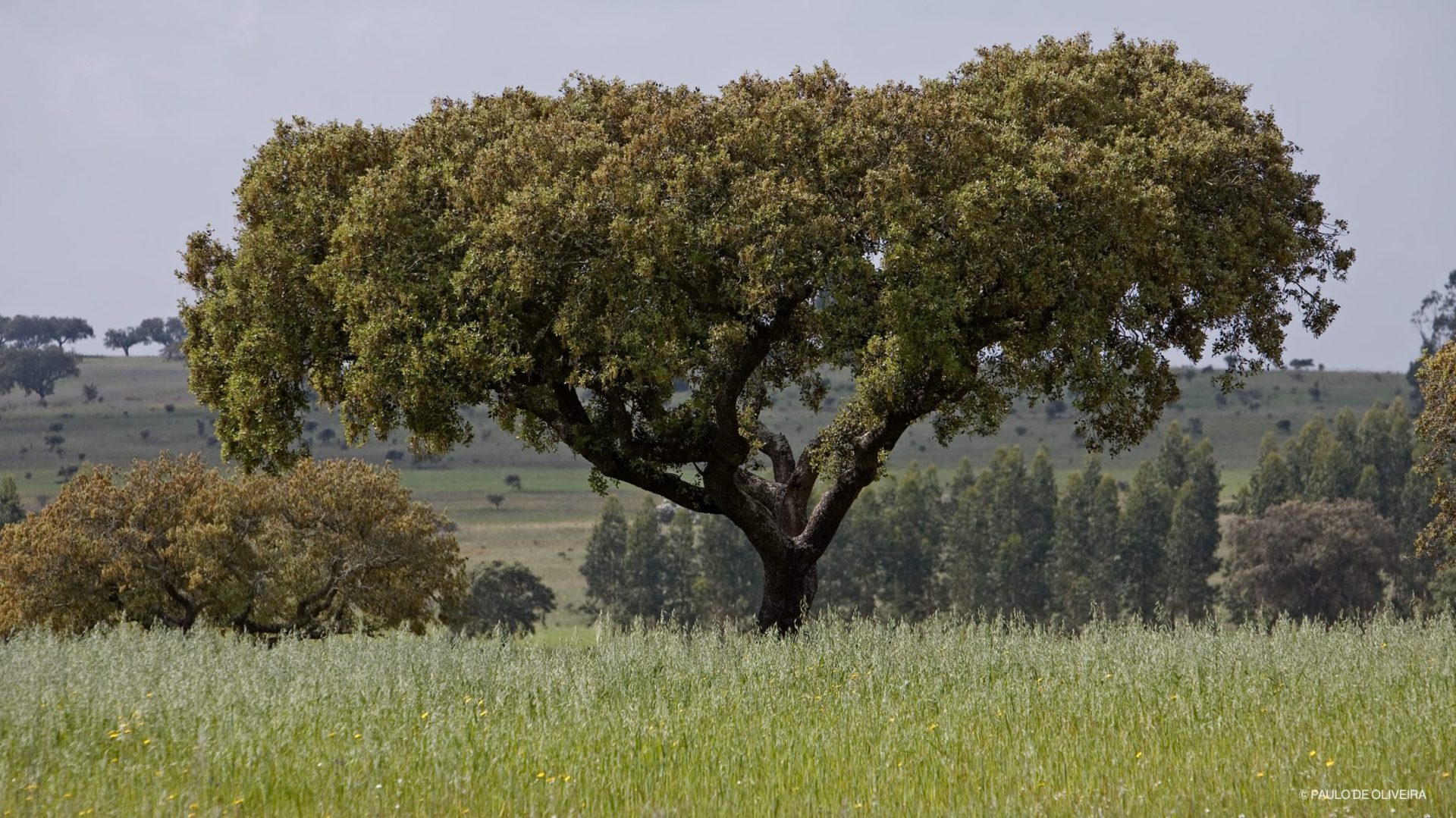


The holm oak is common in the forest and agroforestry areas managed by The Navigator Company, namely in Ribatejo, Alentejo, Trás-os-Montes and Beira Interior. Emblematic of the Montado, it is present, alongside the cork oak, in several areas corresponding to the two aforementioned Natura Network Habitats: Habitat 6310 “Montado of evergreen Quercus spp.”, where approximately 100 hectares in the Aljustrel region stand out, and Habitat 9340 “Forests of Quercus ilex and Quercus rotundifolia”, identified across around 400 hectares (either isolated or in combination with other habitats) on the company’s properties.
Imprima ou partilhe nas suas redes sociais:
Holm oaks and cork oaks benefit from a protection (buffer) zone where no soil disturbance takes place, in order to safeguard the trees, their root systems, and the rich biodiversity surrounding them. Natural regeneration is prioritised, with only targeted silvicultural measures being carried out — such as phytosanitary control, management of excessive vegetation, or stand densification — which contribute to the balance of these ecosystems. Planting has been standard practice in situations where natural regeneration proves insufficient.
The holm oak is one of the featured species in the Zambujo reCover project, which launched in late 2022 to carry out the ecological restoration of more than 150 hectares on a Navigator Company property — Zambujo — located in the municipality of Idanha-a-Nova, within the Tejo Internacional Natural Park.
The intervention aims, among other objectives, to increase this territory’s resilience to the effects of climate change, by improving soils — many of them rocky and subject to high levels of erosion — and the habitat conditions at Zambujo, where several protected habitats have been identified (including 9340), along with around 100 plant and animal species.
Find out more here about this project, which began in 2022 and runs throughout 2023.

